Fun Ways to Teach Ballet Vocabulary: 3 Games Your Students Will Love
Let's talk about ballet vocabulary for a minute.
We all know how important it is. Our students need to understand the terminology we use in class, recognize the steps we're asking them to perform, and gradually become comfortable with the language of classical ballet.
But let's be honest. Repeating definitions or asking students to memorize lists of French terms isn't always the most exciting part of learning ballet!
What if we made vocabulary review a little more interactive?
Over the years, I've found that giving students opportunities to recognize, recall, explain, and discuss ballet terminology can make vocabulary work more engaging. And sometimes, a little friendly competition is all it takes to get everyone involved.
Here are my ways to bring more variety into your ballet vocabulary review, along with a few ideas for making each activity work for your class time.
1. Help Students Recognize the Terms
Before students can confidently use ballet terminology, they need opportunities to recognize the words and connect them with their meanings.
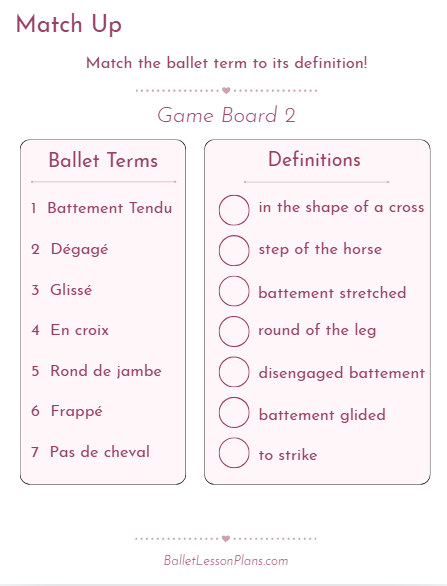
Matching activities are a simple way to practice those connections. Students match a ballet term with its definition, connect terminology with a description of the movement, or work together to review words they've encountered in class.
The key is to make the activity active rather than simply handing students a list to memorize.
Make It Work for Your Class
One of the things I love about vocabulary games is how easily you can adapt them to the class in front of you. Here are a few ways to use a Match Up activity:
Have a small class? Give each student the same worksheet and set a timer. See how many matches they can complete correctly before time runs out. You can have students check their answers together afterward and discuss any terms that gave them trouble.
Divide the class into small groups. Let students work together to complete the activity. You can make it a friendly competition, or simply encourage each group to work toward getting all the answers correct.
Give everyone a job. If students are working together on one worksheet or board, have them choose someone to handle the dry-erase marker and record their answers. The other students can discuss the terms and help decide where each answer belongs. This gives everyone a reason to participate instead of having one student do all the work.
Pair older and younger students. Do you occasionally have a combined-level class because another teacher is absent? Or perhaps you'd like to bring your older students together with your younger dancers for a team-building activity. A vocabulary game can work beautifully for either situation! Just remind the older students that their job is to help, not simply give the answers away. 😉 Encourage them to ask questions, offer clues, and let their younger teammates do some of the thinking.
A Little Strategy Goes a Long Way
Here's another tip to share with your students: Start with what you know!
Encourage them to complete the matches they're confident about first. Then they can use the process of elimination to work through the remaining terms.
Sometimes, identifying the answers they already know makes the unfamiliar ones much easier to figure out. And if they're working in teams, ask them to explain their reasoning rather than simply calling out an answer.
That extra conversation helps you see whether students are making meaningful connections or just guessing.
The Match Up game in my Ballet Vocabulary Games Collection gives you a ready-to-use way to incorporate this kind of review into class. You can use it as an individual activity, a small-group challenge, or a collaborative exercise—and adjust the approach to suit your students.
Remember: The goal isn't just to finish the worksheet first. It's to help students become more familiar with ballet terminology, build confidence, and learn from one another along the way.
2. Encourage Students to Retrieve What They Know
Recognizing a word when they see it is one thing. Remembering it without being given the answer is another!
This is where a guessing game can be useful. Students have to think about the terminology they've learned, recall the word, and work through the possibilities rather than simply recognize the correct answer on a page.
One of my favorite ways to do this is with a ballet version of Hangman. And the best part? All you need is a dry-erase marker and your studio mirror!
Let's Play Guess the Ballet Term!
I like to use this game at the end of class to reinforce a vocabulary term we've worked with that day. It's also a fun way to finish class with a little friendly competition.
Here's how I play:
1. Divide the class into two teams.
I usually let the dancers choose team names, provided it doesn't take too long to decide. We have dancing to do, after all! 😉
2. Choose your mystery term.
Think of a ballet term you've used in class or one you'd like the students to review. Draw a short line on the mirror for each letter of the word.
3. Set up your ballet version of Hangman.
I draw a ballet barre on the mirror, then add the parts of a dancer as the game progresses. Of course, this isn't just any stick figure! I've drawn arms in ballet poses, legs in ballet positions, a tutu, a bun, pointe shoes or ballet slippers, eyes, a nose, a mouth, earrings—you name it!
You can make your dancer as simple or as elaborate as you like. That's part of the fun.
4. Let the teams take turns.
Teams alternate choosing a letter or guessing the term. If the letter is in the word, fill it in on the appropriate line. If it isn't, add another part to your dancer.
Here's my teacher tip: Make the dancers work together to choose their letter. Don't let one confident student do all the guessing for the team! Give everyone a chance to contribute and agree on their answer before they call it out.
5. Offer a clue if they get stuck.
If the teams are having trouble, I'll offer the definition of the term. Sometimes that little nudge is all they need to make the connection.
And when someone guesses the word correctly, take a moment to review what it means. Can the dancers demonstrate the movement? Did we use it in today's class? Can they explain the term in their own words?
The point isn't simply to win the game. It's to retrieve what they've learned and strengthen their understanding of the terminology.
A Few Practical Tips
Plan for the time you have. If you're using the game as a quick end-of-class activity, choose one relevant term—perhaps something you worked on in class that day. If you'd like to make it a larger part of your class, you can easily fill more time with several rounds. Choose a handful of terms ahead of time so you're ready to move from one game to the next without having to think up the next word on the spot.
Choose terms thoughtfully. Start with familiar vocabulary, especially with younger students. You can increase the challenge as their knowledge grows.
Connect the game to the lesson. A term used in today's barre or center work makes a wonderful end-of-class review.
Keep a washcloth handy! I keep one in my bag to wipe the dry-erase marker off the mirror when we're finished. Just make sure your studio's mirrors are suitable for dry-erase markers and follow the studio's cleaning guidance.
Keep it lighthearted. The silly ballet-dancer drawings can be just as entertaining as guessing the word. The goal is to finish class with students thinking about ballet terminology—and having fun doing it.
You don't need an elaborate setup or a stack of printed worksheets to make vocabulary review engaging. Sometimes, a marker, a mirror, and a little imagination are all you need!
An Added Bonus: Spelling Practice!
There's another benefit to this game that I particularly like: it reinforces spelling, too!
As students guess letters, they see each one appear in its correct place within the word. Little by little, the complete ballet term takes shape right in front of them.
They're thinking about the terminology, recalling the letters, recognizing the spelling pattern, and working together to solve the puzzle—all while playing a game.
And because ballet terminology includes so many French words, those extra opportunities to see and think about the spelling can be especially useful.
It's a fun way to reinforce more than one skill at a time without turning the end of class into another spelling test!
3. All-Three: Read It, Show It, Name It!
Some vocabulary games ask students to recognize a term. Others ask them to recall it. All-Three brings those skills together—and gets the dancers up and moving!
This is one of those activities that might look like mayhem to someone walking past the studio, but there's a lot of learning happening. Students are reading ballet terminology, thinking about what the words mean, demonstrating steps, observing their classmates, and trying to identify the term they're being shown.
And the dancers love it!
How to Play All-Three
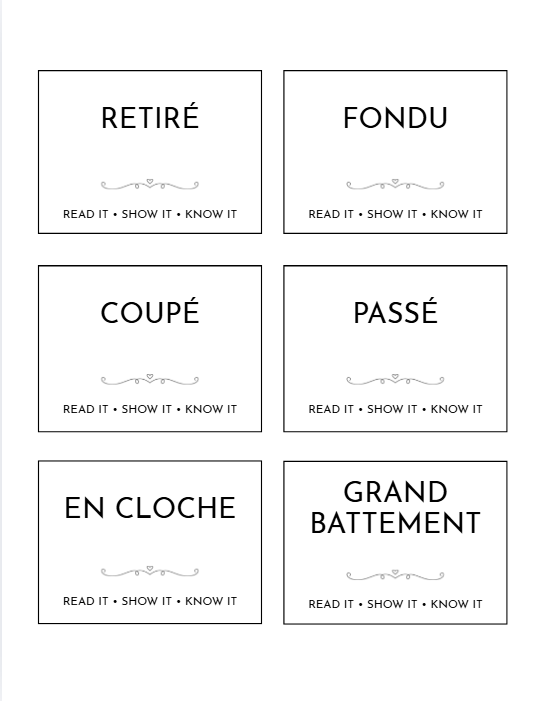
Each dancer has a ballet term taped to their back where they can't see it. The other dancers read the term and demonstrate the step or movement for them. The dancer with the card on their back must watch the demonstrations, recognize the movement, and say the name of the term.
When a dancer correctly identifies their term, they bring the card to the teacher to confirm their answer.
Depending on the size of your class, you can divide the dancers into smaller groups or have everyone work together. Each group works through its terms until everyone has had a turn. Then you can give them a fresh set of terms and play again.
Here's where the teaching happens.
When a Dancer Gets Stuck
Sometimes the demonstrating dancers are doing everything correctly, but the dancer guessing the term just can't remember its name. We've all been there! You know the step, you've done it a million times, but suddenly the name has disappeared from your brain.
Or perhaps the dancer knows the answer but is nervous about pronouncing the French term incorrectly.
When that happens, I ask the dancers to come to me. I check that the demonstrations are correct (and offer plenty of compliments when they are!), then remove the card from the guessing dancer's back so they can read the term for themselves.
That moment connects several important pieces of learning. The dancer has seen the movement, thought about what it might be, and now gets to read the actual term and say it aloud. They're connecting what they observed with what they remembered—and what the movement is really called.
Sometimes the problem isn't the guessing dancer at all. The demonstrating dancers may be able to read and pronounce the term but have no idea how to show it!
In that case, I send the guessing dancer to the other side of the room so they can't hear us. I start by giving the demonstrating dancers the definition to see if that sparks their memory. If it doesn't, I demonstrate the step myself. You should see their eyes light up! They run right back to the guessing dancer, ready to try again. 😂
These little moments are part of what makes the game so useful. Students learn that knowing a word, understanding its meaning, and being able to demonstrate it are related skills—but they aren't always the same thing.
A Teacher's Most Important Job: Build Confidence
Before we begin, I remind my dancers to be patient and complimentary with the person guessing. Nobody should feel rushed, embarrassed, or made to feel silly for forgetting a name.
I also choose the terms carefully when I tape the cards to their backs. I know which students are ready for a more challenging word and which might benefit from an easier, more familiar term. A new student or a dancer who's a little shy may need a term they can identify confidently.
That small decision can make a real difference. The goal isn't to catch someone who doesn't know an answer. It's to give every dancer an opportunity to participate, think, learn, and succeed.
Keep the Activity Organized (As Much As Possible!)
All-Three can get a little chaotic when everyone is moving around the studio, so a little planning helps.
Use smaller groups when needed. If your class is large, divide the dancers into manageable groups. A smaller class may be able to work together as one team.
Prepare your terms ahead of time. I keep the terms for Team 1 together. When that group finishes, I set those cards aside to use with Team 2 the next time we play. That way, I can keep track of which terms each group has used.
Choose a range of difficulty. Mix familiar terms with a few that will stretch your students' knowledge, taking each dancer's experience and confidence into account.
Make time to reflect. When the game ends, I ask each dancer which term stuck with them and whether they think they'll remember to bring it with them into their next class.
That last step is especially valuable. If several groups struggled with the same term, I bring the dancers together to talk it through. We discuss what the step looks like, how to connect the word with the movement, and how we might use it in a combination. Sometimes, putting the term back into the context of our dancing is exactly what helps it stick.
Why Parents Appreciate This Game, Too
I've never met a parent who didn't appreciate this activity once I explained what the dancers were doing and learning.
It may look like a game of running around the studio, but the dancers are reading terminology, interpreting movement, demonstrating steps, recalling names, and practicing pronunciation. They're also learning to work together, be patient with one another, and keep trying when an answer doesn't come immediately.
It's a whole lot more than guessing a word on someone's back. And when students are learning while they're having fun, that's a win for everyone!
One Last Teacher Tip: Think About the Order and the Time!
When I use all three games in class, I usually start with Match Up, move on to All-Three, and finish with Guess the Ballet Term.
There's a method to my madness! Match Up gets the vocabulary review started, All-Three gets the dancers up and moving, and Guess the Ballet Term brings things back to a calmer, seated activity.
I don't necessarily want my dancers leaving the studio on a vocabulary-game high! 😂 Ending with something quieter helps us bring the energy down before class is over.
You can also use any one of these games as a stand-alone activity and easily fill an entire hour-long class with vocabulary review. Or, if you'd rather incorporate games into your regular ballet class, you can break them into shorter segments of about 20 minutes. Just be sure to set a timer! It's surprisingly easy to let a fun activity run longer than planned.
Of course, you can adjust the order and timing to suit your class, your students, and the time you have available. And there's no need to finish every term or even every game in one class. Sometimes class time runs out, and that's perfectly fine. The learning still happened!
4. Make Vocabulary Review a Regular Part of Your Teaching Toolkit
You don't need to turn every ballet class into a vocabulary game. And you certainly don't need to create a brand-new activity every week!
Instead, keep a few options available and use them when they make sense for your students.
A vocabulary game might be useful when you want to:
Review terminology before introducing a new combination.
Revisit words students haven't used in a while.
Add variety to a class routine.
Give students a small-group activity.
Reinforce concepts you've already taught.
Make use of a few extra minutes in class.
Break the ice when new dancers join your class.
Plan a special vocabulary class before a holiday break or during a particularly demanding time at school.
That last one is worth considering! I've found that right before a holiday break or spring break, or when older students are buried in school exams, a vocabulary class can be a welcome change of pace. They're still showing up for ballet, even when they're tired and have a lot on their minds. Sometimes it's nice to say, "Let's do vocabulary today!"
It's a chance to review, laugh, work together, and learn without the usual demands of a technique-focused class.
Of course, you don't need to devote an entire class to vocabulary. You can play one game at the beginning of class to break the ice, use one at the end as a fun review, or set aside a longer portion of class when it suits your students.
There are no rules about how you have to use these activities. Do what works for you!
You can repeat games, change the terms, adjust the challenge, and adapt the format to suit your students. That's the beauty of having reusable teaching resources. Once you've prepared the materials, you can bring them out again whenever you need them.
Think of them as tools to keep in your back pocket—ready for the days when you want to reinforce learning, add variety, or simply do something a little different.
Ready to Make Ballet Vocabulary More Interactive?
I created the Ballet Vocabulary Games Collection to give ballet teachers practical, reusable tools for working with terminology in class.
The collection includes three games:
Match Up — an opportunity to recognize and connect vocabulary.
Guess the Ballet Term — a challenge to retrieve and recall terminology.
All-Three — an interactive way for students to read, demonstrate, recognize, and name ballet steps.
You'll also find reusable game materials, a vocabulary bank, teacher guidance, and an answer key to help you put the activities to work.
The collection is designed to give you options, not dictate how you teach. You know your students, their experience, and what they're ready to learn. Choose the terminology that suits your class, adjust the challenge, and make the games your own.
Because learning ballet vocabulary isn't just about remembering French words. It's about helping dancers understand the language of the art form they're studying.
Teach your way. Make learning engaging. And keep building a toolkit that works for you.
Explore the Ballet Vocabulary Games Collection →
Find this resource and more tools for ballet teachers at BalletLessonPlans.com.